Posts

Screen Time Project

Image
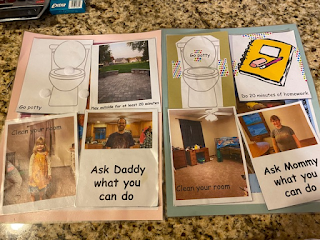
 Hi Parents! I wanted to put myself out there a little to tell you about a parenting project I'm trying at home. My 6- and 3.5-year olds love their screen time. The 6-year-old loves his video games, and the 3-year-old is always asking for iPad. My husband and I try to limit their screen time, but we're mentally managing so much as two working parents. Managing screen time just becomes one more thing. And honestly, we probably give in at times and give them screens because we need some quiet time just to get things done around the house. Or sneak in a quick nap. Whenever we do this, I feel guilty. Too much screen time is not good for their developing brains, and there are other things they could do if I had the brain space to think of them. So, I thought of a plan, a system inspired by my observations of special educations classes. It's a task completion board. Here are some pictures: The above picture shows a task board with 4 tasks for each kid. These particular ones are g...

Acknowledging the Uncomfortable (An editorial)

School is in full swing, now. I guess. It's very weird. We, teachers, are here at our buildings every day, but most of our students are not. Roughly 1/3rd* of our students are remote and the remaining 2/3rd* are split between A days and B days, with some exceptions. Staff has been in session for 27 days, A-schedule kids have been in session for 12 days, and B-schedule kids have been in session for 11 days. The start to this school year has been different and weird and, quite honestly, uncomfortable. Some students and staff are worried about getting sick. We know parents are worried about how to teach their kids at home and maintain their job responsibilities. I've seen parents get frustrated for kids being sent home with minor physical ailments because no one really understands the nature of the Covid-19 virus. Social distancing and masks are all over the place. It’s a lot. Most of us are wondering, “When is this going to end?”  Because this has been different and weird and unc...

Coronavirus Break, Day 1

Dear Parents, "We are living in unprecedented times!" I bet you have been hearing this phrase a lot, lately. What our community, country, and world are going through right now is just...surreal. It's hard to believe this is all happening. It's confusing and scary and packed with a whole lot of uncertainty. No one who is alive now has been through anything like this. If you're like me, you've probably got a lot of thoughts swimming through your head, so let's break them down. Here's what we know so far: There's a brand new virus that's got some scary symptoms that's going around the entire planet. There are some cases of this virus in the United States, including in Illinois. Illinois Governor Pritzker has ordered public and private K-12 schools to close from March 17-30, in hopes of slowing the spread of the illness. As of now, here's what we're doing to move forward: Pekin Public School Dist. 108 is closing school Mar...

"Worry, Worry, Worry! You Know What I Mean?"

Image
The title for this post comes from the book Wilma Jean the Worry Machine by Julia Cook. It is the book that I have used for January's and February's lessons for 2nd and 3rd grade. In January, I read Jonathan James and the WhatIf Monster  to 1st grade and When I'm Feeling Scared  for kindergarten. In February, I will focus on building coping skills for anxiety for grades 1-3 and coping with anger for kindergarten. I decided to cover the topic of fear and anxiety based on data I collected from parents at the end of last school year and because so many of the student referrals I receive have connections to anxiety. Spotting Anxiety in Kids Sometimes, anxiety in kids is easy to spot. They may cry or cling to a parent. They may say how they are scared. Other times, anxiety can be sneaky and show itself in ways we don't expect, like through aggression or refusal to follow directions. This happens because anxiety causes a stress response, so the body and brain go into f...

How to Avoid Overstimulation in Kids Over the Holidays

Image
The holiday season is known for it's colorful lights, twinkling music, beautiful decorations, and it's many activities. So many activities. There are parades, Christmas concerts, parties, visits to Santa, shopping trips, and even tours of our beloved local attraction, the East Peoria Festival of Lights. There's a lot going on, so much, that it often leads to overstimulation in kids. What is overstimulation? Overstimulation occurs when "a child is swamped by more experiences, sensations, noise and activity than she can cope with" ( https://raisingchildren.net.au/newborns/behaviour/common-concerns/overstimulation#signs-of-overstimulation-nav-title ). Imagine you're having a Nerf battle with your kids. You could probably take a few hits from the soft projectiles without being bothered, but if you are being pelted with them, you might run away, duck and cover, or rally in a counterattack. This is what's it's like for a kid's brai...

My kid has been diagnosed with ADHD. Now what?

Image
What does it mean to have ADHD? ADHD is a disorder of the brain. Brains are very complicated, even to a brain surgeon. The workings of a brains are hard to understand. If a normal brain is hard to understand, imagine how a differently-working brain can be misunderstood. Here are some basic facts about ADHD to help you more fully understand the diagnosis: What having ADHD means: Your child's brain takes in information or stimuli differently. Your child's brain organizes information or stimuli differently. Your child struggles with paying attention...sometimes. Other times, your child may hyperfocus on, or pay A LOT of attention to, something that interests him/her. Your child may be more sensitive than others to certain noises, smells, tastes, or to movement or visual stimuli. Your child may have difficulty regulating, or controlling, their emotions. Your child is awesome! What having ADHD doesn't mean: Your child is dumb. Some kids with AD...

Catching some Zzzzzz's

Image
Sleep and Your Student's Behavior One of the Cardinal Rules at CB Smith is "Do your best learning." Both Starke and Willow have a rule about taking care of ourselves. One very important way we can do our best learning and  tkae care of ourselves is to get a good night's sleep. Good sleep habits, or sleep hygiene, can help us bring our "A Game" to school. Not enough sleep for our students can lead to learning difficulties, thorny behavior problems, and mood managing issues. Teachers and support staff have often noticed that individual students struggle more with choose good behaviors on days when they don't get a good night's sleep. (The day after Halloween is universally difficult at school.) Sometimes, we suspect that chronic thorny behaviors are a result of poor sleep or not enough sleep over many days and/or weeks. To help your student get a good night's sleep throughout the school year, follow these tips. Tips for Good Sleep Habit...

Identifying and Diagnosing ADHD

Attention Deficit Hyperactivity Disorder (ADHD) is a disorder that is discussed in may schools and in many classrooms. Many parents and teachers wonder if a child, who can't seem to sit still or pay attention in class, has ADHD. It's a delicate topic between parents and their children's teachers, especially at the primary age because normal behaviors for these young children can look like behaviors seen with children who have an ADHD diagnosis. Honestly, it can be hard to tell the difference between normal social-emotional development, delayed social-emotional development, and ADHD. Today, I want to connect you  to information that will help you understand ADHD and the behaviors of the children who have it.  Because ADHD is such a complex disorder this blog entry will cover identifying ADHD and how it's diagnosed. Statistics from the Center of Disease Control (CDC) In 2016: Approximately 9.4% of children 2-17 years of age (6.1 million) had ever been diagnosed ...

Responsive Classroom

For the past few years, Pekin Public School District 108 has been gradually implementing the practices of Responsive Classroom to bolster social-emotional skills and academic learning.  "Responsive Classroom  is a student-centered, social and emotional learning approach to teaching and discipline. It is comprised of a set of research, and evidence-based practices designed to create safe, joyful, and engaging classroom and school communities for both students and teachers." - from responsiveclassroom.org  You many not have heard of it because we often refer to the different parts of Responsive Classroom or we just work them into the day. The students probably won't hear us talk about Responsive Classroom directly. What you may hear about is Morning Meeting, Quiet Time, or Closing Circle, all things that we do to build community and transition to different parts of the school day. Each school and each classroom implements Responsive Classroom differently. Ther...

Reboot!

Image
Hi Parents, Teachers, and Other Important Adults! Welcome back to a brand new year! I'm so excited to be back and see all the kids and teachers! It's going to be a good year! Last year, I started a blog to help inform you, parents, about the material I was covering in my SEL (Social-Emotional Learning) lessons in each classroom. I posted about once a month before my efforts fizzled out as my case load started to build. I did not meet my goal of posting at least once per month. BUT...I want to try again. My posts may be shorter, but I'm hoping giving myself permission to write shorter posts will keep me motivated to post more often. If you, the reader, find these posts helpful but want to see them more often, feel free to email me at erin.heilman@pekin108.org. I love it when others hold me accountable. (Seriously.) I will also take topic suggestions. What do you want to learn about? What issues is your kiddo having that I can help with? Email me or make a suggestion i...

November SEL -- Using Kind Language

Image
November's SEL (Social-Emotional Learning) focus was using kind language. More specifically, we focused on how to solve conflict with others using kind words. It sometimes feel natural and maybe even justified to use mean words, but we can fix and keep friendships and good working relationships with others if we use kind words. Kindergarten -- Saying, "No." We read a book called, Let's Talk About Saying No. It talked about the right times to say no like when someone (a kid) asks us to do something we don't want to do or shouldn't do. We also talked about a kind way to say no: "No, thank you." "No, but maybe later." "No, my mom/dad/teacher said I shouldn't." We also talked about when we should say, "OK," or "Yes," like when a parent, teacher, or adults asks us to do something we need to do like clean up. To reinforce this lesson, we played the "Yes/No" game where students were asked ...

October SEL - Personal Space

Image
Personal space is the amount of space each of us needs to feel comfortable in our surroundings. In October, all grades will be discussing personal space and what it means to them. Third Grade: Learning goal: Students will know what it means to respect others' personal spaces and value their own personal space. Activities: Short videos on personal space, space bubble experiment, and discussion. Second Grade: Learning goal: Students will know situations and people that might cause personal space bubbles to change sizes. Students will also know how to communicate to someone that they would like more space. Activities: Watch "Close Enough!" on YouTube, discuss sizes of space bubbles, how to know you're in someone's space bubble, and how to ask someone to move out of your space bubble. First Grade: Learning goal: Students will learn what personal space bubbles are and why they are important. Activities: Read and discuss Personal Space Camp  by Julia Coo...

Tips on Easing Separation Anxiety at School

Image
It's that time of year when we tend to see some separation anxiety. Sometimes, students just show some first day jitters when everything is new. Sometimes, separation anxiety appears when there is a big change in a kid's life. Either way, it's often difficult, even heart breaking, for parents and loved ones to watch their "littles" cry out for them at drop off. Parents, rest assured that usually this is a short-lived phase. In the meantime, here are some tips with easing your student's separation anxiety. Make good-bye routines quick. I recommend parents do the “Hug and Go” – give your student a big hug, say goodbye, and leave. Lingering usually makes the pleas for Mommy or Daddy to stay become more intense. Be consistent. As much as you can, make the drop off to school at the same time every day. Keep your routine the same every day. This predictability will help your child feel safe.    Don’t go back. Returning to the classroom/school to check o...

September SEL -- Listening

Image
Listening is a very important social skill for children to learn. It's a tool they will use in school for learning, and a tool they will use the rest of their lives. We never stop listening to others! Good listening skills not only help us learn in school, but they also help us keep and make friends and work well with others. For our SEL (Social-Emotional Learning) lessons this month, we will focus on one particular component of listening per grade level. Here is a summary of what we're doing in our lessons: Third Grade Learning goal: Active listening. Active listening shows that you are listening to understand someone else. Activities: Interactive modeling of active listening and in-class practice for students. Second Grade Learning goal: Strengthening listening skills by watching and decoding body language Activities: PowerPoint presentation on how we show body language through our eyes and eyebrows, mouths, hands and arms, legs and feet, and posture; Interpreting...

Happy New School Year!

Parents and Important Grownups, Welcome back to school! We're happy to see your students, and we're excited about the new year that stretches before us! I'm excited about getting to know all the students and helping them learn and grow. Speaking of learning and growing, we, teachers, know that learning works best when the new things we learn are supported in many settings. That's why I want to keep you posted on what our social-emotional lessons are about throughout the year. When I first started several years ago, I tried relaying that info home to parents through take-home letters, but that took a lot of paper. I tried writing school newsletter articles, but the articles ended up being too long for a newsletter. So now, I would like to try writing a blog. In this blog, I'll highlight what I am teaching in my school-wide social emotional lessons. I will also have some tips of things you can do at home with your student to encourage them to use these skills. Plea...